Friday, August 7, 2020

Day 5:  COVID19  Pre-Planning - Reflections on Professional Relationships

I had planned on a different topic for today, but it seems so heavy for a day that feels light - I will hold that one until next week.

This morning I got to work and found a message from one of my former colleagues who is also a great friend.  She is retired now and glad to be, but she was checking in and sending her empathy for us still teaching - hearing from her was a great way to start my morning.   She was an amazing teacher who loved what she did and loved working with kids both as a math teacher and a coach.  She was a geometry guru and one of those teachers who always rolled her sleeves up and dug in to reach as many kids as she could.  She was always learning and growing and looking for better ways and resources  to hone her craft.  The profession really needs her right now, but she is enjoying retirement, and I am happy that she is off enjoying life - she deserves it!!!

Last night I talked with another former colleague that I worked with for the first 7 years of my career.  She and I both taught math, and we shared a love of reading.  We were both on facebook talking once again about books and sharing ideas and suggestions.  We are both reading/studying social justice issues right now, and we were sharing knowledge and specifics of Thomas Jefferson in light of our reading. She no longer lives in Atlanta, but this friendship and shared love of books has lasted through time and across states.

Yesterday afternoon one of my closest teacher friends in my district - we worked at 2 different high schools together and started teaching the same year - called me on MS Teams.  We got caught up on our personal lives and shared our pre-planning experiences so far this year at 2 different schools.  Our friendship started with the best story and has grown so much over the past 15 years - I am sure I will dedicate a blog to our journey at some point!  We had touched base over the months of COVID19 quarantine and interact on social media, but is was nice to see her "in person" even virtually.

The first day of pre-planning this week I texted back and forth with my friend who teaches in a neighboring county about what it was like to be back and what our school systems were doing.  There is a fair amount of added stress in her district right now, and I feel so much for her.  I met her through Twitter Math Camp and the twitter network a couple of years ago.  We are both transplants from the midwest, so we have that culture connection along with our passion for teaching math, and I love having friends in different counties in the Atlanta metro area to network with!

Through this past week I have been collaborating with a couple of teachers at my former school that I used to coach.  I connected one of them with my colleague here that is teaching the same content course since and sent an amazing activity on geometric proofs with uno cards.  The other teaches the same course right now, so we have agreed to stay connected and plan together this year.

One night this week on twitter one of my colleagues/friend in North Carolina posted and shared a cool journal writing activity she is giving to check in on and and monitor student well being.  We chatted about that on Twitter, and I thanked her for a book suggestion she gave me over the summer.  We did a zoom meeting to discuss the book "How to be an Anti-Racist" by Ibram Kendi.  We then also shared how our schools were handling this coming school year between different states.  I told her I wanted our department to do a book study together, and she made a great suggestion of "Weapons of Math Destruction" as a first book.  She was also someone I met through the Twitter math network and a conference last summer.  

Our Blaugust coordinator from Oklahoma reached out to me also no Twitter to things I have share in my blogs this week - it was great inspiration to keep blogging, which has also greatly enhanced my week of pre-planning.  It gives me structure to my day, reflection, and purpose in this crazy time.

My two algebra 1 colleagues/friends and I continued our 3-way daily texting throughout the week and all of its events - this kept us sane through the summer, and it has proven to continue to do so.

And lastly, I cannot express enough how therapeutic it has been to be around my colleagues this week even if it is mostly virtual or at a distance with a mask if a couple of us are in a room.  We are all used to being apart in the summers, but this past year was a longer stretch with being home for 2.5 months before summer and not reconvening even at the end of school.  

We are all stressed, crazy busy with little knowledge of what we need to busy with sometimes, worried about the kids and ourselves, but at least we are closer together.  We had all these feels the past few months too, but we were all isolated at home away from each other.  Now at least we can eat outside as long as we social distance (and we do), talk to each other one on one at a distance, and we meet together everyday virtually.  We bonded as a department last semester with two out on sick leave for weeks and having to scramble and then going through COVID19 in a new remote world.  It is nice to be back closer together and know we have each other.  Together we will get through this - together we are better!

So the theme for today is how important all of my professional relationships are to my career my journey of teaching.  This is not a full list, but what an amazing many for even just a week in!  The is absolutely no way I would have made it through this career without the colleagues I have worked and resulting friendships I have made along the way.

As teachers we need these connections, we thrive when connecting to others that share our passions.  I am fortunate to have found many of those connections.  We educate children - that is no easy task, and no one person does that alone with any effectiveness.   It takes us working together within our content area, across content areas, and also connecting on social media; now more than ever our support systems are critical.

To all my friends/colleagues with in the local, state, and national levels - thank you SO much for your collaboration in education, your friendship; this blog is for you.  The energy I derive from working and socializing with you keeps my passion going and enhances my career and my personal life.  

Three other positive things for today -

1.  It's Friday!!!

2.  Talked to my best friend in Minnesota for awhile today!

3.  Today is cat adoption day!!!


Thursday, August 6, 2020

Day 4 - Virtual Pre-Planning

So yesterday I was in virtual meetings from the time I walked in the building until 2pm.  MS Teams/Turnitin, Department, PLC, and Readiness and standardized assessment training; the last one mentioned gets its own blog tomorrow.  

All of these were pretty much back to back, and many of them not productive.  At 2pm I was absolutely brain dead and exhausted.  I tried to pull some planning together for this morning, but I was far too scattered.  Worse, I did not get to go walking at lunch, so at my desk sedentary all day save for bathroom breaks.

The epiphany here is this is our students new reality everyday virtual classes all day long.  They get a 10 minute break between classes and a 45 minute lunch, but still - pretty brutal.  Now I am not saying that I think we should turn the tide - anyone who read my post yesterday would know I support remote learning for safety reasons.  I have always realized the drawbacks, but yesterday I lived them.

Now after walking through this reality I understand our administration's call for fewer/smaller homework assignments and more work during class periods.  I would not have swayed from the request anyway, but I see it now.  

Some things I think are worth considering as we head into this new platform with our students:

1. Make the beginning of class personable.  Conduct a class poll to check in on students and talk about
    results.  My department chair did this yesterday in our meeting, and it was a great ice-breaker.

2.  Keep direct instructional time as interactive as possible - that was what one meeting leader did to 
     keep me engaged in one meeting yesterday.

3.  Keep direct instructional time short - if you need to instruct more, provide a follow up video for 
     them to view on their own at their own pace.  20 minutes is plenty.  

4.  Provide for plenty of group work with reinforcing activities frequently.  In my classroom normally I
     do a lot of learning checks and board share for class analysis, so that being gone - working together 
     with me popping into channels is needed.  MS Teams is a great platform for this.

5.  Allow for stretch breaks if there is direct instruction.

6.  Talk to students about taking a break between school and any work at night at home.  Some will 
      have sports in between, but many will not.  Encourage them to get outside during lunch if possible. 
      They need to be reminded daily for a while until habits form in this new normal.

7.  Have them post or record their thoughts and/or questions somewhere at the end of class.  Another 
     poll for understanding level would be great at this time.  I intend to use virtual name tents, and I
     have a friend in NC who is using online journals.

8.  Checking in through polls, discussion, group work, etc. will keep them invested, engaged, and 
     realizing that their presence as a member of the class is important, wanted, and needed.  It allows for
     an inclusive environment on a learning platform that is designed to work against us all if we do not
     navigate it in productive ways.

Never have we been more challenged more as teachers AND students than we are now.  We cannot bring old practices to this environment, and some of them need to be left behind anyway.  In rising to this challenge we learn as educators right along with the students and hone our craft.  I already realize that there are many things from teaching virtually that I will want to keep, and there are some things that I did before that I am ready to toss.

It's is and will continue to be hard, exhausting, nerve-racking, but I do believe we can find reward in this process as well.  It will take rolling up our sleeves, willingness to be uncomfortable, and allowing ourselves grace in stumbling and rebooting.   

It will also call for us to have that same grace and patients with our students.  They will be absent, they will have internet issues, they will need understanding for what they have to balance with family obligations - some of those very likely to be sickness in this time period.

Patience, kindness, and understanding are critical for all of us as we navigate this new school year.   Be relatable with students and share your struggles and the fact that you understand their stress as you are experiencing it too.  In doing this you appear real and more tangible to them as well as more approachable for what they may need from you.

We are all in this together, and we must band together to get through it.  

Together we are better!

And finally - 3 positive things as I start my day today:

1.  I have most of the day to get work done for my classes.

2.  I have a hair appointment after school - that is always a treat.

3.  My department chair and I had a good talk yesterday afternoon that left me feeling energized about 
     leading the Algebra 1 team.


Wednesday, August 5, 2020

COVID19, the New School Year, and Frustrating Realities...

I would like to ask you to take yourself back in time to August of 2019...  Close your eyes and go back there, to the pre-covid days at the start of a new school year.

Now look at this picture below - If I had asked you back then "What do you Notice?  What do you Wonder?" ....  What would you have said?


I am guessing you may have wondered "why are there a few students wearing a face mask?"

Let's forward to now - August 2020 with the same question of what you notice, wonder.  I am guessing for a lot of us, unfortunately not enough of us, would be something like this:  "why are there ONLY a few students wearing masks????"  For teachers - we are definitely asking this question, and the picture is frightening.

What a difference a year makes, and not in a good way.  I long for life before COVID19 like anyone else, but I realize that is gone forever and act accordingly.  I am infuriated with the ignorance we now see in the face of a global pandemic that we still don't know enough about to be making the decisions some people are making.  I grow tired and weary of those in our population who choose only to pay attention to the science that serves our instant gratification and ignore the science that challenges us and makes us uncomfortable.  I am angry as hell at the decision many of us have made to just turn the other cheek and walk away from the patience that mother nature asks of us until she and modern science come to an agreement.

This is a picture of a high school in the suburbs of Atlanta this past Monday on their 1st day of school.  It is not the only high school that went back full face to face, and pictures of this and many others are planted all over the news here and nationally.  As seen here, there is no social distancing and very few students wearing masks even though they are "strongly encouraged" to be doing so.  The hallways are FULL, which means the classrooms are FULL; very few students wearing masks.  Masks are not mandated in Georgia, so there you have it.

This school and many others are serving as a laboratory experiment for what happens when we reach only to our comfort levels, do not let science run the course of discovery/invention and prevention, and open up schools during a global pandemic.  A global pandemic where thousands of people are dying everyday and those who survive are facing long-term, possibly permanent physical effects of this disease.  

What a disgusting thing to do to children, teachers, administration, and other vital staff in the building.  Here's the kicker - what a disgusting thing to do to our population - students go home to loved ones every day.   We fail our whole society on this one.  We fail teachers when we are this careless - they have been made to be expendable teaching in buildings where students are not required to wear masks, and they are not supplied enough protective gear.  We have failed our children by putting them in a situation where they can get sick or die, watch their peers and/or teachers get sick or die, or bring it home to family that could get sick or die. 

And guess what - we have also failed students because we have taught them to be selfish and careless - both socially and with respect to science.  In the words of my biological scientist best friend, mother nature will bite you, science has the propensity to help us with that if we give it the time to do so, but we have to have patience and change our behavior.

We have a real chance with this generation to teach them to be citizens of the world, and as a teacher of this generation, I can honestly say this generation is eager and curious to learn about this world and how to be responsible and caring in it.  Our chance is now, and we cannot just talk at them - we must lead by example.  So many of us are, but conversely and most dangerous is that many of us are not. 

To those of us that do act for the good of all, our hands become tied when we have leaders at the local, state, and national level that do not make responsible decisions for the good of all and in caution of a disease that is constantly changing and adapting new patterns.  Our hands are tied when we have leaders that act only on "preliminary information"  to the charge of children do not get sick as much or that they do not spread disease.  

How do we even know that?  They went out of school at the beginning of this, and they have not been back in school until now.  Around the world the countries who truly flattened the curve and take monetary care to properly protect everyone have been successful reopening schools.  Those that went too early have had disease spread and closed again.  Are we so arrogant that we think we will be different?

It appears we are from this picture, from the school leaders that support the measures for opening the school in this picture and so many others to the government leaders that have not mandated wearing masks.  Also included are the citizens of our country who believe their rights exceed all other facets of everyone's lives.  School leaders and businesses are being asked to make the decisions that government leaders should have.  

How did we get there?  The answer to that has so many stripes - too many to talk about here.

So -

To the parents that stand out with signs and protested for our school leaders to let their students go back to school because they "will be so far behind"  or  "need it for their emotional health":

Will you be proud you held that sign if your child end up on a ventilator in a hospital and you cannot be there with them.  Or if you have to look over your child's casket in worse case scenario?

Will you be proud you held that sign if you have to bury a loved one that gets seriously ill from COVID19 or dies?

Will you be proud that you held that sign if your child's emotional health suffers from the loss of a friend(s) and/or their teacher(s)?

Will you be proud that you held that you held that sign if spread of the virus includes new mutations that render a new vaccine useless and prolongs this pandemic?

Will you care how far behind your child is in school when they are seriously ill or are no longer alive?  

If you can still say "yes" to all of the above questions, then that is your platform, and we can agree to disagree, but at least you hold consistent.  If you say "no" to even one of these questions, YOU are the problem; and there are too many of YOU.

It's not too late to change our path - the question is will we before it's too late.  Do not forget that the right that we ALL do in fact have is to vote in November.  I pray we change course before then.

To all my teacher friends heading back into schools in direct risk - my heart absolutely goes out to you.  I know you will wrap your heart around those kids and teach them because it is what we do.  Stay as safe as you possibly can and know that even those of us who do not have to go back yet have your back and are thinking of you daily.  


Tuesday, August 4, 2020

Day 2 Pre-Planning During COVID19 - Feeling Better...

I was actually excited to be in the routine of getting to school this morning.  I had not looked forward to hair and make-up every morning again, but I forgot what a quiet bit of time it gave me to wake up in the morning and sift through my thoughts.  Also - right now with people working remotely in Atlanta, the traffic is a blessing in disguise, so the drive to work is peaceful too.

Lots of virtual meetings yesterday, but it was nice to be on Teams together because we could see each other's faces, relax, and get some laughs in.  Big topic of the day was the grading plan set forth by our district, which is pretty nutty although it does leave room for some needed growth and change.  

One big thing the grading policy during remote allows for is reinforcement of building relationships with students, and I see it as an opportunity to build relationships with parents in a way we have not done before.  Remote platforms allow for easier conferencing and opportunity for "parent office hours" - best of all, that does not have to go away even when we are face to face again someday.  In my early days of teaching when email was still the main source of communication home, I sent weekly parent emails/updates and was the first in my department then to do so.  The parents really appreciated it, and I liked the pro-active communication versus first contact only when there was an issue.  Relationships need to be built immediately in order for trust the grow productively.

Well, desktop updates suggest the day is ramping up with first meetings.  I hear laughter in the hall right now, even more added improvement for today!

Three positive things for today:

1.  The traffic to school is light making the drive easy and peaceful.
2.  I feel like I am in my old routine again - it is like putting on a pair of old pajamas.
3.  I am going to be adopting a new cat this week - more fur baby therapy at home!

Monday, August 3, 2020

Pre-Planning in COVID-19 - New, Scary, All the Feels!

Today is the first day of pre-planning in my district, and staff is back in the building.  We are starting universal remote learning for the year with the students in 2 weeks, but teachers are required to work in the buildings at least for now.

Here I am back in my room sitting at my desk looking at student desks that no one will sit in for who knows how long, which is fine if it is not safe, but weird.  I have seen a couple of my colleagues and though it is great to see them, it is also hard because we cannot see each other's faces, hug, or even get close to each other.  We can see each other's eyes, and all eyes I have seen are pretty apprehensive; I have heard no laughter. 

Pre-planning is normally a pretty exciting day for teachers - the start of a fresh new year.  Many of us have not seen each other in weeks, we hug, high five, hang-out in each other's rooms while setting up, go to lunch together, welcome new department members, and share our dreams and goals for the year.  This year that is all virtual, the excitement is gone and replaced by anxiety, uncertainty, and fear of getting sick by being in the building or even worse.

In the last 2 weeks it has been a daily struggle to wrap my head around all of this and how it will go.  Though we all did virtual remote learning last spring and learned enough for us and our students to survive, we now need to transition to thriving while the students are not in the classroom.  I know we can and most definitely will do it, but where to start?  How to keep it up daily along with keeping our emotions and fears at bay?  Will we even see our kids this semester?  When will school ever resemble what it once was?

So, I have decided to pick 3 positive things to remind myself of daily while starting my day.  I will write them down and refer to them when things get tough or seem impossible.  Here are my 3 for today:

1.  I completed my required MS Teams training this past weekend, so not only is it done ahead of time,
     but I was excited about all the features that can help me keep things I love to do in my classroom as
     well as new ideas.

2.  All of the furniture that is supposed to be in my room made it back to my room after the summer!

3.  I am working on great PLC teams this year!

In closing for now, to all the teachers across my state and in our nation that have to go back today or soon with students, my hear goes out to you in every way.  I absolutely cannot imagine that level of stress right now on top of this.  I will be thinking of you and sending good thoughts your way in that you stay healthy with protective measures in place.


Wednesday, January 3, 2018

Opening Pandora’s Trig Box – Unit Circle Socratic Seminar

This was my most exciting project this semester.  I have implemented both formal and informal Socratic Seminars in the past, but this time I decided to go out on a limb by using it to introduce a new concept.  In fact, I used it to introduce one of the most important concepts in trigonometry – the Unit Circle.

One of my past mentors in college always said I was a “take the bull by the horns” type of person, and that personality in my surely came through on this one.  For weeks before I oscillated between the “are you nuts Tara?” and the “I am so excited about this” thoughts on a daily basis; during the school day sometimes on an hourly basis.

I have taught the Unit Circle at least a couple of times before, but it was always flat, and the beauty of this concept deserved much more.  This time around, I was determined to be as creative and student-driven with it as I could be.  It was a huge risk, I was playing with their trig foundation, but I was committed to giving them an experience learning it that was fun, exploratory, and long lasting.  It worked, it was an amazing experience for me to create this activity and then watch as they put smaller ideas together with oohs and aahs throughout the seminar; to watch them derive and form the single most important concept for use and application in trigonometry.  Did my colleagues raise their eyebrows at me when I talked about what I was going to do – of course!  Just as they had done when I began Socratic Seminars at my old school.   That just fueled my intentions as always!

The Journey to Pandora’s Box

I hyped it up – of course I did, I am a math nut that way.  I kept telling them we would be opening Pandora’s trig box for key concepts that contribute to a very important trig foundation.  They kept arguing that Pandora’s box ended up containing evil.  I got cheesy with it telling them that some evil is necessary and can transition to beauty if you can get past the uncomfortable mystery of it.  Some students had friends in Accelerated Pre-Calculus, one level above honors pre-calculus, and they had already heard about the Unit Circle and that it was painful.  They would ask when we were going to learn it, and I told them they were going to discover it and develop it themselves.  They looked at me in shock, I told them I wanted them to find the beauty and patterns in it, so their experience was not painful.  I told them to trust me, and that they did.

The ideas were swimming around in my head, I knew I wanted them to take parts and put them together like a puzzle.  I started developing the activities I would give them to draw out their knowledge and start making connections.  The following are pictures and explanations of each.

“Angle Order” – This is where I integrated the ideas behind Clothesline math, but without the string.  They way in which they received the assignment made it too hard to get a string with cards going – you will see as this story develops.  Still, I had them order radian measure from least to greatest in and around the 0˚, 90˚, 180˚, and 360˚ values, which were the only angles they knew the radian measures to at this point without conversion.  I did not tell them to place the radian angles they already knew, the intent was for them to use that as a basis on their own.  I would later find out that many did just that, and that certainly was evident in the Socratic discussion. 


“Radian Reference Angles” – This had 2 intentions, to bring back the idea of reference angles and give more practice with them, and then also to allow students a visual follow-up to the order of radian angles around the unit circle.  I could not even hazard a proper estimate of how many times the term “reference angle” was used in Socratic discussion when it had been a less than popular topic when introduced before radians and the unit circle.


A Scattering of Previous Ideas – These 4 cards contained ideas that would enhance work with reference angles, and “terminal points” was an early on concept that I had not given much air time to in the days leading up to the seminar.  It was the concept they needed for the coordinate values on the circle, but that was for them to put together.   They did just that during the seminar, but probably not with the prep assignment when prompted.  That was OK, that was just what I wanted them to do – define it in their own words, and then apply it to break away into unit circle values.


Which One Does Not Belong? – I could not resist!  There is a beautiful visual pattern that develops as the Unit Circle develops, and I wanted that to be somewhere in their minds before the seminar without knowing why it was in their minds.  That was the discussion point right before the seminar formally started – there were many different choices among them for which one did not belong to the subject matter at hand, and they were all arguing their points.  This is the entire nature of what “Which One Does Not Belong” is intended for.  There are no wrong answers rather an answer that may “fit” better in a specific situation or parameter.  This was one of the most fun pieces I put into the mix!

“What is the Connection Here?” – We had reviewed their past right triangle trigonometry in the week before the seminar.  We had also talked about quadrants and the positivity and negativity of x and y in the coordinate plane as well as axes coordinate points.  They had not seen the circle on the plane yet in our discussions, and I had not used a hypotenuse of 1 intentionally in the right triangle trig review.  We had discussed and used Pythagorean theorem both in exact and approximate values, used the trig ratios of sine, cosine, and tangent only in exact values, but not with hypotenuse 1.  I saved that for this connection; I wanted to see if they could start to integrate the idea of hypotenuse of 1 can connect into circle of radius 1.


Picking their Brains:   “Points to Ponder” -  This was a guide sheet to go along with the other activities I developed and prompt thought and connections of those ideas.  I reinforced A LOT when they were given this activity that I wanted them to explore with their thoughts and own individual answers and that at this stage of the game, there were no wrong answers; only their own understanding was required and also sacred.


The files for the above activities can be downloaded here:  Pandora's Trig Box Activities


The Implementation of and Opening Pandora’s Box.

First of all, I wanted their pre-seminar assignment of my activities to be different than they had ever experienced in math.  I also wanted it to be distributed in a way that reflected the suspense of the Pandora concept.  For a few weeks, I had my eye on the treasure box in one of our workroom suites that was covered in old-world maps.  I did not have to convince the secretary in that suite very much to let me borrow it – she said I could have it.  Although I told her I would return it, it still sits in my room by my desk because the whole project was a true treasure in our classroom, and I am not ready to let go of it yet!

The two weeks before the seminar, I began prepping the activities.  I copied them onto color copy paper, and double copied many of them onto on side to make the papers they would work with smaller pieces of paper.  I then folded each activity individually in different ways, the “Which One Does Not Belong” activity was in the form of a scroll, and a couple of the activities were folded into the ways we used to fold notes that we passed back in forth in junior high back in my day.  The funny thing with that was they thought it was some sort of exquisite origami paper folding art rather than what I knew it to be.  Perhaps it was, the generational gap between me and them in the age of cell phones for communication kept me from realizing that they would not see it the same way as my memories did.  Such a cool and unexpected element of the experience!

I placed each folded activity into a sandwich bag, and I then placed all the bags (90 in all) into the treasure chest I scored from the copy room.  Was that a lot of work-yes it was.  Was it worth it – a million times over when watching their reactions to it.  I brought the treasure chest to school, and the seminar was scheduled for Monday, October 16th, so I gave them their seminar prep-work homework in sandwich bags on the Friday before.

Seminar prep - homework bags for students and tucking them into Pandora's Trig Box:


I hyped this up too – I let each class pick the person who would open Pandora’s box.  Those students played into it well creeping up to the box and taking a bag.  Then all students were curious as to what in the world was in each bag, so mayhem to get their own bag ensued.  It was a lot of fun watching them open their bags and unfold the activities and start talking about the things they were going to have to do.  The “Which One Does Not Belong” activity was the instant hit.  I encouraged them strongly to work on that part individually first and come together Monday with their thoughts.  I guarantee they had never received a “bag of homework” in math before, and they were intrigued.   My kids are great, and I knew this was a solid truth this day when the main question they asked in amazement was “didn’t this take you forever to do?” or “how long did this take you to do?”.   I told them that yes it had taken a lot of time, but it was every bit worth it to me for them to learn what was ahead and I meant that with all my heart.  This was also they day I would realize in reflection later that we formed a strong, trusting bond as students and teacher.


Students opening Pandora's Trig Box and finding the clues for the seminar prep work:


The Unit Circle Seminar


The day of the seminar arrived.  I had assigned roles to all students; they did not know before that day if they would be in the discussion circle, the writeboard writer's circle, or the observe and record circle.  Because they participate in Socratic Seminars in their ELA and Social Studies courses, they knew what each role entailed, and I also provided a 10-minute Q & A session on the structure of a math Socratic the previous Friday before opening Pandora’s Box.   I assigned students into roles based of data that I had collected from the previous quiz, and characteristics in my students that I had discovered thus far into the year. 

Classroom set -up for seminar:


Data from Previous Quiz:  I gave a Likert Scale response question on the previous quiz (not for points on the quiz), which asked them to rate from 1 – 5 any previous knowledge they had of the unit circle.  The leaders of the discussion group were chosen from those reporting a 5 rating on the question, and the discussion and writing groups were chosen in a mixture of a few 3-4 ratings and more 1-2 ratings.  I wanted some knowledge to be in each group to keep discussion transitioning, but I also wanted a fair number of students who were in pure discovery and connection mode.

Student Characteristics:   I put students who were shyer in the writer’s circle, so they could still contribute their ideas and knowledge via whiteboard, and so they would not be so stressed by the pressure of speaking in the spotlight of the discussion group.  As with any classroom, there are very eager and verbal students that like to answer all the questions if they could, and for this activity, they were assigned the role of observe and record.  It is true that the leader of the discussion group has the role of managing the discussion to avoid participants monopolizing the discussion, but I did not want to place that stress on them the first time we had a seminar in our classroom.  It is not that I do not value the eager students’ knowledge, but I knew that they would share their knowledge in their ,  and know how to effectively transcribe the contributions of others.

Resources used during the seminar were as follows:
  • A projected image of a Unit Circle Template on the whiteboard   
  • Each student had a paper copy of the template to reference at their desks and their bag of seminar-prep homework; nothing else was allowed on their desks.
  • The discussion group (inner circle) and whiteboard writing group (2nd-ring circle) were not allowed pencils that could stifle group discussion.
  • The third ring circle was comprised of students assigned to observe and record the contributions of the discussion group.  Each member of this circle was given a blank unit circle template, allowed to use pencils or pens, and was assigned one member of the discussion group to follow.
  • My role was to record the contributions of the whiteboard writing circle, and provide prompts if needed.

A more detailed explanation of each of the roles in the seminar along with the evaluation tools I used can be found on a previous blog I wrote:   Socratic Seminars in the Math Classroom - Why Not?

Summary

As I stated in the beginning of this blog, I was so nervous to try this and knew there was a risk of it not serving the purpose intended.  I opened the seminar by projecting a blank unit circle template onto the white board and saying  “There are 64 Important Facts to Know Within this Image, You May Now Begin the Journey to Finding Them!”

My fears were quickly alleviated within the first few minutes of the first seminar and transformed into amazement.  The interpretations of the prep-work I gave them came flowing out of them as they worked to put all the elements of the unit circle together.  There were two students assigned to scribe the information onto a unit circle template, and they found challenge if keeping up with scribing the flow of ideas coming out of discussion.  There was so much use and proficientcy of vocabulary that I did not realize they had in their discussions.  Below are a few of my favorite quotes from students:

  •  “What are we supposed to fill in for the coordinate points?  Oh wait, are those the terminal points?”
  • “I think we get the terminal points by referencing the angles to form triangles and find the sides”
  • “I thought ordering the angles in radians was easy  because I know that sixths are smaller than fourths and fourths are smaller than thirds.”  (This was my all-time favorite contribution – evidence of pure number talk!)
  • “I think this one does not belong because it has pi only in the circle, and everything else we learned before with degrees”
  • “Does this mean the x-value is always the adjacent side and the y-value is always the opposite side?”
  • “How does tangent tie into this – is it x over y?”
  •  “Oh wait – it is this one that does not belong here because it is more complex and what we had to figure out”


I know there are many more, but I just cannot remember them all, nor could I get them all down on paper as I observed and recorded the process.   The worry I had about executing this topic in a Socratic Seminar was quickly canceled out by the amazing discovery and connection of previous ideas they had and collective efforts they displayed in putting together the puzzle that is the Unit Circle.  Each of the three periods of students had their own way of bringing the development of the Unit Circle to completion.   One of the classes experienced more roadblocks than others needing more prompting from me, but my prompts were only in the form of further questions.  In the end, this class overcame the roadblocks and got everything tied together minus the idea of tangent values.  Though they did not take it as far as the other two classes, the ability to push through the challenge and uncomfortable spots gives them a different type of strength with just as much value. 
Here is a quick video recording of the start of one of the seminars.  The teacher I am mentoring recorded the whole thing, but it gets cut down in the link-up:

Seminar Video:


The message I wish to share in all of this is to run with ideas you are truly passionate about no matter how risky they may seem; the passion will carry you through it and help you to make it work.  Do not worry about raised eyebrows and those who question rather, tell them you will let them know.  If you truly believe in it, you will develop an unforgettable experience for your students with sustainable learning that you will then be able to share with others!


TMC 2017 – Reflections

For me, I went straight into pre-planning the day after Twitter Math Camp 2017.  Though I started writing this piece about a week after school started, I am just now finding the kind of rest and relaxation to give it proper air time and reflection.   I would have liked a few days or so to digest all the awesome ideas I got at TMC17 before returning to school, but the energy I had from it was a huge plus for enthusiasm going into a new school year.   Now four months later, I am embracing the chance to talk about my conference experience in an applied way.

Looking Back to the Conference Itself with a Quick Glance/Reflection

This was my first year attending Twitter Math Camp, and a lucky thing was that I live in the Atlanta area, so I did not have to travel out of state to go.  I did however, avoid the Atlanta commute by staying at the TMC17 designated hotel.  The benefit of that far outweighed just saving commute time – it allowed for so much more opportunity to meet new people, socialize, and enjoy meals and evening activities with new friends.

I had put in a proposal to do a morning session on Socratic Seminars.  I only had 2 people come to the session on Thursday, so I went ahead and closed it because just needed a few more than that for it to be meaningful, and I did not want them to miss out on something else that could be really influential to their craft by staying.  The good thing that did come out of Friday morning after I closed the session was meeting and talking with Daniel Forrester, who was the point person from Holy Innocents for TMC17.   I did share my materials with him and talk about the Socratic seminars and how they worked.  We are both teaching Pre-calculus this year, so we extended our visit to swapping ideas for that course.  We also exchanged contact email for sharing throughout the year.  He is an amazing person and I am sure an awesome teacher.  Had I not needed technical help for my session, and then not had my session, this conversation never would have ensued- one of many great things!

I was able to meet some great people and go to some amazing afternoon sessions including Glenn Waddell’s session on math concepts that carry through K-12 math courses and how to enhance them at every level, Chase Orton’s session on calculus concepts for early ages, Anna Vance’s “Make it Stick” session, and I was lucky enough to get in on an added “Clothesline Math” session by Chris Shore.  All of this great stuff was in addition to the fantastic keynote speakers each day and the “Favorite Things” talks at lunch each day.

How TMC17 Enhanced My Classroom Fall Semester 2017

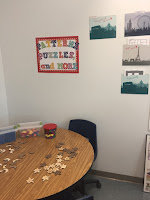
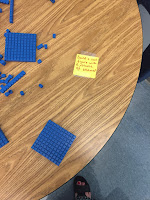
One great thing that happened at TMC17 was seeing my student teacher supervisor Christopher Danielson again.  I had ordered his turtle and pentagonal tiles, and he was kind enough to bring them to the conference for me rather than ship them out.  It gave us a chance to catch up and he shared with me his latest passion of working with “Math on a Stick” at the Minnesota state fair as well as his hopes to expand on it however he can.  Christopher has always been a passionate educator and champion for conceptual understanding, and I love that he has taken this to the “ground up” approach with #tmwyk and tactile ways of letting people of all ages engage in “Math Play”.    The tiles he delivered were the first step I took in creating a math play table in my classroom.   The kids absolutely love it, and I have added to it as the semester progressed.   My husband was not sure how this would work in a high school classroom, but I was proud to report back with pictures of football players “at play” on the table.  He was flabbergasted, but intrigued.  He became a believer in it as he progressed through his curriculum and training for a second career math teaching degree.  He wants to teach geometry, so I know when the time comes, I will have to make sure he does not start stealing my tiles for his classroom!  Though it was my play table, my husband was yet another pre-service teacher influenced by the ideas and skills, and knowledge of Christopher Danielson. 
Below are some pictures of the play table this semester:  Thanks Christopher!

I absolutely loved Glenn Waddell Jr’s session:  “Bridging Elementary Skills & Concepts to High School & Beyond”.  In this session, he highlighted fraction work/exposure from early elementary on through the bridging ideas of intermediate and middle school concepts of common factors and multiples that lead to fractions in the form of rational expressions in high school algebra.  This year I am teaching Honors Pre-Calculus, and in the beginning of the year our pre-requisite work involved review of the operations of rational expressions.  I took extra time and used Glenn’s approach and bridging of elementary, intermediate, and middle grades concepts to build for a deeper understanding of rational expression work for review.  Since the application of these operations would manifest itself in operations for verifying trig identities later in the semester, I knew it was a now or never thing to get the conceptual understanding as solidified as possible.  Wow did it work well!  I have never seen students at this level master this concept so well and with such depth; especially the addition/subtraction work rational expressions.  Further, their strength in mastery of that operation carried through very well during trig identity proofs 3 months later.   His ideas and work with connecting concepts across the grades is a winning addition to our craft-Thank you Glenn!

Our classroom play table in various stages this semester:


Elissa Miller shared a classroom management practice she uses for a “My Favorites” presentation.  I believe she calls it “Two Nice Things”.   The ideas is that she uses this when kids say unkind things to their peers in her classroom.  For every unkind thing a student says towards another, she then expects them to share two nice things about that student.  This really resonated with me as a great way to turn negative comraderie into a positive act in a classroom.  I started this immediately into the semester, and it worked so well.  Double-edged sword is this:  I stopped having to do this early on in the fall, which was great in that it meant students were more respectful of each other, but I did like giving them the experience to think about the balance of positive and negative feedback as it is an important life-skill and such a necessary one to our craft.  Thanks Elissa!

Anna Vance’s “Make it Stick” session was solidifying for me.  I had read the book and loved it, but the ideas of spacing, lagging, and spiraling were still seemed like such a blended concept to me rather than separate intentions.  Her session helped me to develop them as separate entities in my mind and figure out which ones I had implemented and what I wanted to add in the future.  Last year I started to spiral homework, but it fell by the way side early.  This year I decided to continue work with this concept first and got further with it this semester, but the cramming in the end due to missed weather days off set the attempt in the end.  I will continue with spiraling of concepts next semester, but in a way that probably mirrors more of the spacing concept.  I want to keep students working on concepts that need strengthening and reinforcing as they venture toward Calculus next year.  Even though I have not seen this practice through consistently, I believe it has really helped students in the times that we were able to do this.  Thanks Anna for straightening these concepts out for me!

Clothesline math presented by Chris Shore is an incredible concept – the proof is concrete in that there was demand for a second session of it at TMC17 AND the room was packed to the gills!  I integrated this concept into my fall Unit Circle Socratic Seminar, which will be a separate blog to follow this one.  I did not actually use the string, but the concept of it was there and played an important role in the development of radian use on the unit circle for the students.  There is so much great work that can be done with number sense across all grade levels involving this strategy, and I would love for our new Algebra 1 team to learn this method, but time and lack of funding for professional development got in the way for first semester.  I am hoping we can find the time to show our new team this at some point this semester.  Thank you Chris!

Ideas from TMC17 that I Plan to Drive My Second Semester Instruction

I attended the Desmos session on the Wednesday before the conference began.  At this session, there were break-out sessions developed for the afternoon.  I attended Chase Orton’s session on calculus concepts for early ages.  In this session, he talked about the concept of area in early grades extend into non-vertex edge images/curves in an estimation sense; further, to use concrete area calculation to drive the estimation.  I had never thought of connecting this idea so early and in parallel to usual area concepts and calculations.  As I look to second semester with my Honors Pre-Calculus class and think to our algebraic units this coming semester in preparation for Calculus, this will be a concept I embrace when looking at graphs of functions.  We have the time to do it as I have just “functions” penciled into the calendar, so what a great way to enhance the study of the curves of functions they know and lose redundancy that is typical in this practice.  Thanks Chase – I cannot wait!

Lastly, I went to a session on standards-based grading given by Tony Riehl and Jennifer Brackney:  “Standards-Based Grading in a Traditional Setting”.  This was so informative for me on the ideas of implementation of this practice as our district is and has always been a traditional grading district.  A beginning contradiction to that, our district has started piloting standards-based grading practices in a few of the elementary schools with intent to expand into all grades at some point.   I had always come across standards-based grading on a 4-point scale when exploring it, but I really liked the presenters’ 10-point system that they developed to bridge the transition from traditional to standards-based grading.  This semester, I am looking to utilize the information and resources they provided in working on my data collection and analysis skills; I need work in that area.  Our department chair is already implementing the practice of posting our standards on our tests this semester, so it seems like a natural pairing.  This will be a big challenge for me, but I am committed to at least developing it along with her request.  I really like the objectiveness that it brings to the table of evaluation of student skills, and I am hoping I can find enough success with it to share in further development of our Algebra 1 and Geometry initiative for next year.  Thank you Tony an Jennifer for providing this valuable information for traditional-based classrooms to involve themselves in a more growth-orientated mindset!

In closing, there is so much more I experienced at TMC17, but I would be writing for days and days; I wanted to highlight the experiences that have and will receive real-time application this year.  Though I wish my session at TMC17 would have come to fruition, I realize it was pre-mature of me to try to speak at a first Twitter Math Camp being a newcomer.  I wish I had allowed myself the opportunity to be a participant at one of the other morning sessions given how much I drew out of the shorter afternoon sessions.  Those sessions have driven my instruction thus far this year and fuel my excitement for more implementation for 2nd semester as I sit here and write 2 days before going back to semester 2 pre-planning.    I am hoping I will get the chance to experience a thorough and in-depth morning session as well as more afternoons sessions in Cleveland as I do plan to enter the registration lottery in February.  With holiday festivities over for all of us and a new semester in the dead of winter ensues, 

I am hoping the timing of my reflection of TMC17 can help boost the yearly excitement we all feel for TMC this time of year because the professional development and relationships we form at TMC are priceless!