Sunday, August 14, 2016

The First Week:  We are on Bell Schedule #2...

And there are actually 8 different bell schedules in my new school - the struggle to learn them is real, trust me.  My goal is to know bell schedule #1, the regular schedule, by the end of the year:)

On last blog, I walked readers through the tornado of the last day of pre-planning.  I was able to get a few things done over the weekend to help more with the first week, but I was really still just starting with what I call the bare basics.  Still, I was excited to meet my kids, and because I teach all freshmen, we were all coming to Alpharetta HS and our classroom for the first time together. 
Most of my colleagues cringe when they hear that I teach all freshmen, and maybe my readers do to, but I can tell you that I absolutely LOVE working with freshmen.  They are still young enough that I can do some of that fun stuff that exists more in middle school, but they are also old enough that I can start the big kid classroom responsibilities too.   They are transitioning to a big, new experience, and I love to mentor them through this experience.  To me, it is the perfect grade to impart a lot of shaping and molding of their high school math experience and teach them good work habits they can carry forth to be successful in high school.

I will highlight the first two days in detail and then go from there in  a more general sense.  The first two days were absolutely the best even though I was really behind from the teacher sideline.

Monday 8/8;  This was our first day.  In all classes, we briefly went over the syllabus – I don’t like to hammer too much of that because they won’t remember it, and it is on my website.  In Accelerated Algebra 1 we had to give a pre-test to see if there were students who may want to re-consider honors.  I don’t like giving a pre-test on the first day of school, but in case a student was misplaced, we did not want them to suffer.  Our school was in over count, so we needed to watch numbers and be careful of placement.  In Algebra 1, we did not give a pre-test; no need to and wanted the time for meet and greet.  I did a colors meet and greet where students took 2 color squares from a bag and then we went around the room having them answer specific questions related to the color they picked.  Questions involved things like favorite movie, book, vacation, and sport.  I love this activity for the first day because I can start learning about personalities of my students immediately.

Another favorite activity of mine on first day that I got to do with all of my students was have them fill out a student “Auto-Biography”.  It is really a “Mathography”, but I incorporated a couple of non-math questions on it this year.  I have not done this in a few years, and I now realize how much I missed it.  I got the idea from when I student taught in Minneapolis.  I believe it was part of the CPM curriculum that the district had adopted right before school started.  I do not read them until Saturday after the first week and never have because I want  to try and have some faces to go with the writing.
Here is a download for the student “Auto-Biography”:  Student Auto-Biography 


Tuesday 8/9:  Then of course on the night of the first day, I found  Sara Van Der Werf’s post on the Name Tents, which totally hooked me in!  I really had no time to do this project, but Sara is very persuasive.  That together with the fact that when I find something I like, off I go, and no one can stop me, I was doing it.   I wanted to use this tool to get to know my students in the time until I could read their auto-bios.  Because  they were coming in from 2 middle school feeders, it would definitely a good way to meet and get to know each other.   So, Tuesday morning at 7am I am editing Sara’s version and running off copies while pulling out color paper to glue them to (I had no time to go and get card stock the night before).  Still the color paper backing worked just fine in the long run thank goodness.  Because advisement was before 1st period most of the week, I had time to glue the comment/question page to the orange paper then.  I was a crazy person for that 30 minutes, but I got enough done for the periods before lunch.  Luckily I was assigned seniors for advisement this year, and they are always about as into advisement as I  am- I was able to get it done.

The name tents were a hit.  The students loved them, loved decorating them just a little more each day, and communicated some great thoughts to me.  I left the “question for me day” until Friday, and because we started the name tents on Tuesday, I had them do two days the first time.  Again,  this is where having freshmen is fun – I made the Monday question be:  Name something cool that happened on your first day of high school!  A lot of them said they were happy they did not get lost-I told them they were a step ahead of me as I had gotten lost in our huge building during pre-planning!

For any of you yet to start school, I totally recommend this idea.  It does take time, but it is SO worth it.  Additionally, when I answered the questions from Friday on the weekend, I also used the tents as flashcards to see how many faces I could put with names; total win-win-win opportunity!
Here is the link to Sara's name tent blog: Sara VDW's Name Tent Blog - A MUST SEE!!!


Another awesome thing that happened Tuesday was starting number talks and cool activities in my support class.  I had been saving a first day idea from a post by Megan Schmidt back in July about Minnesota temperature/heat index changes within 6 months.  Because I used to live there, I definitely know how brutal these extremes can be.  I think most people know Minnesota is really cold in the winter, but I do not think they realize that it can also be hotter than the south during parts of the summer.  Anyway, Megan’s post and Sara VDW’s comment about linking it to integer instruction in middle school sparked an idea to use it as a number talk in my first days with support Algebra 1.  

I started it by a map of the United States as I guessed that a lot of my students had never been to Minnesota and was not sure how well they knew the states.  I was right about none of them ever going to Minnesota, so that was a good lead in. I was also correct in that they realized Minnesota gets cold, but did not realize that it ever got really hot.    Once we located MN, I brought up the temperature/heat index comparison image.  We started talking about what they noticed, and a good 10-15 minute talk was spawned.  I asked them to pick a town to compare on the map, and for some reason they picked Wilmer, MN.  I asked them to look at both temps for Wilmer, and try to figure out how much difference in temps/heat index had occurred from the winter to the summer.  They started getting in the ball park, but then my team teacher went ahead and drew a vertical number line to prompt them, which sealed the deal for finding the exact difference.

It was as awesome of a number talked as I could have hoped for.  The students were totally engaged, and the discussion was so interesting.  Below is a picture I posted on Twitter Tuesday 8/9:


The Rest of the Week:  I continued to open up my support class with talking problems from 3-Act Math and Would You Rather.  On Friday 8/12, I did not open with a talk, but I finished class by starting them on solving 3 by 3 Ken-Ken puzzles.  Not every day went as well as Tuesday, but still, the problems are great for getting them thinking and talking.  My support class is different from last year in that I only have them one period, and most of them are not my own students.  It is very tough to build a classroom community this way at the end of every day (I have them 6th period), but it looks like that will be a front-burner project in coming weeks.

In my accelerated and on-level Algebra 1 classes, we are doing interactive notebooks, and the great thing is that they had all done them in middle school and were right on board with the process.  This will be the second full year that I incorporate them, and I am glad they like them too.  They will be getting their surface pro devices this coming week, but as I told them, devices crash – interactive notebooks do not.  One interesting thing that I noticed this weekend from reading their auto-bios is that many of them do not like having 1:1 devices; particularly in math.  I would say from reading their feedback that it is about 50/50 for or against with maybe a slight lean to against.  I think this works  well with the fact that I have not received one yet anyway.  I will never completely do everything in my classroom on the devices, but I do believe it gives them the opportunity to not carry around textbooks all the time, have instant access to teacher websites/Edmodo, and best of all in math:  DESMOS!!!   I think I will post their homework on One Note, but they can opt to print it out or do it on paper if they wish.

Another thing I kept this year was homework check sheets.  I started doing this two years ago, and I love it for many reasons.  I check off their homework every time it is assigned with an expo marker, and every two weeks I take up the check sheet and give them a grade; each homework is worth 4 points, so every 2 weeks is around 24-32 points.  The students keep the sheet with them, and what I noticed the most and made me decide to keep them is that they have a visual gradebook for themselves.  Before I did this, less homework got turned in because they could never see how many points they did or did not have.  When they use these and see zeros, they tend not to make a lot of zeros.  This is also a way to highlight important dates for school.  The sheet is broken up into 3 two-week grade sets, and since we give progress reports every 6 weeks, they know when the progress report is coming.  Here is a link to the stamp sheet: 


The downfall of the week was more and more meetings and never quite catching my breath.  I ended up late at school every night because I had a meeting every day during lunch and housekeeping things to do during planning period.   I had forgotten about my department meeting on Friday 8/12, and after 3rd period prep that day I was feeling for the first time that maybe I was about to get over the hurdle.  Then during 4th period the meeting popped up on my Outlook calendar and frustration seeped out of the edges again.  Again, I was later after school than I planned, and  I still made it to the teacher get together with some of my mathies from a nearby school, but I was completely and utterly “meeting-ed out”  I left school pretty bitter about that.  I have to say, I have never in the years I have been teaching attended so many meetings per week. 

As always, the kiddos pulled me out of my bitter mood.  I spent some of Saturday reading their auto-bios and answering the questions they asked me on their name tents.  I loved reading their responses and answering their question; It instantly pulled me out of my funk and made me excited again to start think about next week.   Again I can affirm that the main thing that keeps teachers coming back to the classroom is the kiddos; both teaching/mentoring them AND all that we learn from them.
Now a weekend later, I feel pretty caught up.  I have materials ready for most of the week, I have the name tents all answered, the auto-bios all read, keys made and loaded to Edmodo, and a couple of blogs written.  Blaugust has not been as bloggy as I had hoped for, but I have written some and hope to keep a couple coming each week at least.

Here’s to week 2 and wishing all who have yet to start the year, a great first week!


Riding The Pre-Planning Roller Coaster:  Part 2

Well, I am writing this over a week later than I had planned, so that says a lot  about how this  day impacted my first  week of school and ability to get to  projects outside of my classroom.  Just as the Wednesday of pre-planning that I wrote about last blog was so energizing and productive (the peak of the roller coaster ride), the Friday of pre-planning became the valley that drained me. 

In between Wednesday and Friday of that week, I had my first Algebra 1 team meeting for which I  am the team lead.  There are  5 of us, and four are new this  year, so that is quite an undertaking for leading a team.  I got them all signed up to dropbox and was planning  on Friday afternoon and early evening to get materials loaded up for them for the first 2 weeks.  We did manage to finalize our syllabus and calendar for the first unit; more specifically the first 2 weeks as we all had to stay on the same page due to students changing schedules.

Then came Friday.  It started out with a department meeting at 8:30am for an hour.  One of my colleagues was leading it and showing us how to work OneNote on our Surface Pro devices, which was informative and helpful as I had already started to play around with the program  on my computer.  I still as I write this have yet to  receive my device, and the students get them this coming Tuesday…   I am not worried about it though because they can utilize them for things other than OneNote while waiting for me to get my device.  They can access my Edmodo site, the course textbook when I do actually assign out of it, and best of all, they can download DESMOS!!!    There is still plenty we can do even if I never get my device. 

The department meeting lasted until 9:30am, and then it was time to start getting all those errands done that I had put off all week.  Most important was the parking pass, which I quickly regretted not getting on the first day of pre-planning.   My department chair had stopped by earlier in the week  to check if I had gotten my parking pass, and I told him it was on the to-do list’ he just smiled and said okay.  We have been professional friends for many years, and he is a very nice guy, so he did not realize that if he was trying to save me from myself he needed to say something like:  “hey dumbass, you need to go get a pass, or you will end up parking behind the school..”.   My former department chair was more of a straight shooter that way, she knew I was terrible at details.

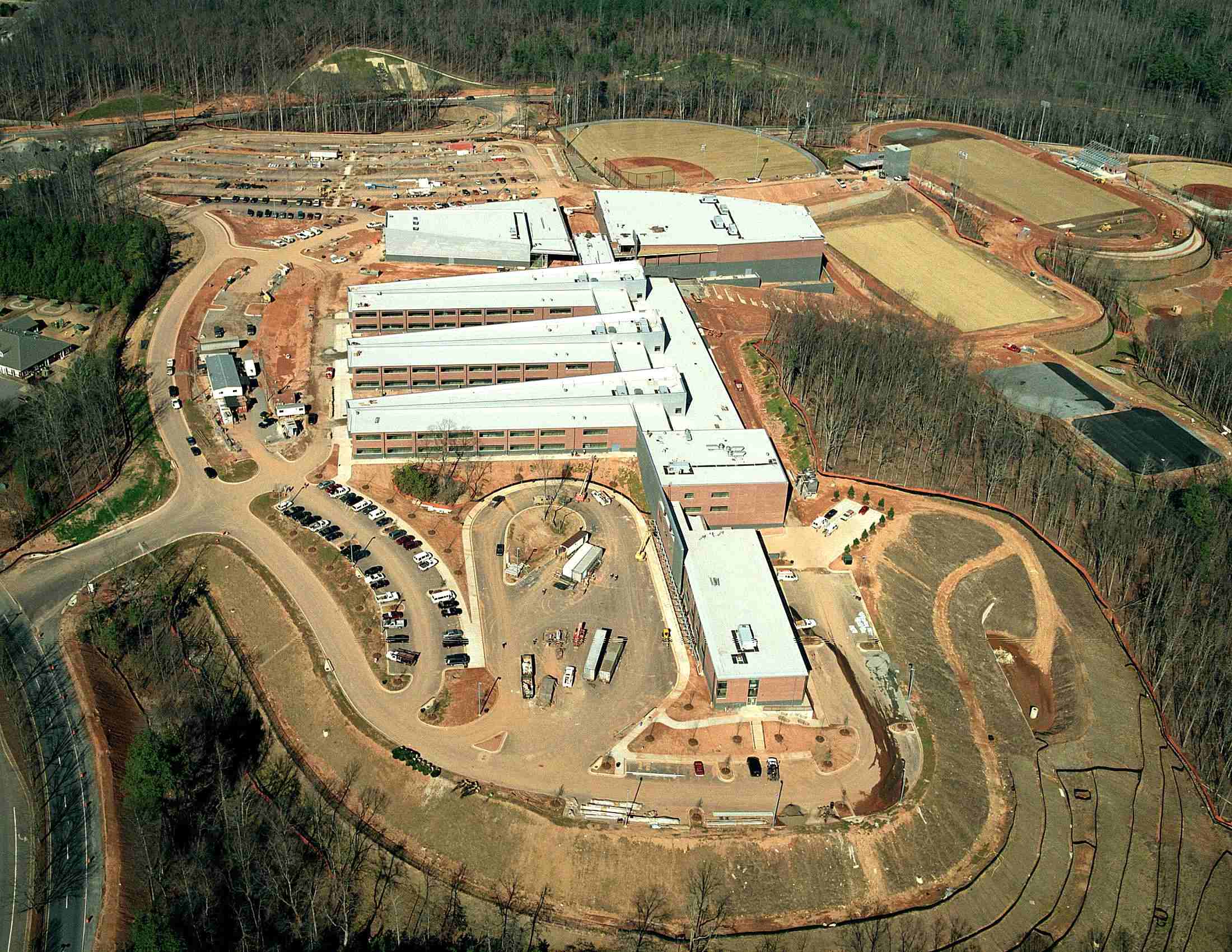
I  quickly learned my lesson.  I ended up assigned in back of the school by the beautiful trees, and this is what our campus looks like except there are trees around it now.


My spot is is behind the corner of the building closest to the bottom right of the image, and my room is at the end of one of the hallways in front.  Enough said.

At 10:30am I had to attend a meeting for one of my Algebra 1 support students whose mother wanted to meet us and bring us up to speed his challenges as he transitions to high school.  It was a good meeting and helpful for me to start thinking about strategies to help him as the school year starts.
This brought me to 11am, and I was supposed to meet a past colleague for lunch at 11:45, so I used the time between to run to the School Box to get some additional supplies for my “not finished” bulletin board and other classroom décor.  I found out that School Box had moved down the street, so that process took up time, and I did not make it to lunch until nearly noon.  It was probably better for my bank account that I did not have extra time at School Box, but it made me feel like there was so much more I wanted to do to my new room.  I decided maybe mid-year (being realistic). 

At 12pm I met my friend.  I had not seen her in almost a year.  She left my former school at the end of 2015 and went to teach at a private school for students needing a different type of school set-up.  She was hoping that would revive her teaching soul, but it was not the right fit, so she is taking the year off to figure out what is next.  I have to admit that on this day at mid-day, I was just a slightly envious of that as I felt the stress and pressure building of the impending first day of school 3 days away.

I got back to school about 1pm.  I had agreed to help one of my Algebra 1 team members start her google-site set-up as that is required of us to carry a website.  We had just sat down to do so and do work together when the admin announced the ethics meeting for all new teachers and strongly suggested for teachers not new to the district but new to the school.  This is where the irritation started seeping out along the edges.  I had planned on 2 solid hours to get the dropbox loaded for my team, and start printing out materials for the following week and Monday’s copies made.  In retrospect, I would have done just that.  On Friday, I still felt that being new to the school meant better not miss a meeting; a week later that perspective has changed a bit.  I learned nothing new at the ethics meeting other than what some people with no scruples will do when left to their own element.  I am not, and never have been that person, and I have carried an ethical approach to my job for the last 12 years and always will.

The meeting lasted from 1:30pm to almost 3pm, and then it was time for our faculty meeting.  I went to that, which was useful information, but I lost the two hours before that could have set a less exhausting tone for the next week.  I finally got back to my room at 4:15pm.  I had not loaded materials to our team folder in dropbox, had nothing printed out, nothing copied.   Further, I was staring at a bulletin board that consisted only of new material stapled to it from 5 days prior; I had intended to have it done already; I completely cracked.

Thankfully my son had planned to help me re-hang some posters that we had not glued enough to the wall and lost the battle to the Georgia August humidity.  He helped me border the bulletin board as well, which was a double layer of black and silver, so not easy to do.  I was able to get it together with his help and only throwing one stapler out of 3 across the room.  Unfortunately, decorating bulletin boards is not my forte, and I have the up most respect for elementary teachers who have to change them several times a year – I could not make it through that!

Even with help and finishing the bulletin board, it was then 6pm, and I still had nothing I had planned done.  It was then coming to the realization  that I would not be prepared beyond Monday, which is not how I like to approach any upcoming week.   Luckily my teacher mentor calmed me down, got me to only focus on what I needed for Monday and let the rest go.  I printed out my syllabus signature sheets, the Auto-Biography that I wanted the students to complete, and the Accelerated Algebra 1 pre-tests that were giving first day.   Another colleague helped by cutting out color squares for the Algebra 1 meet and greet activity, and all that was left was to make the power point to go with the meet and greet activity.

The printing, copying, and organizing of Monday’s materials along with a few other loose ends (drop box loading)  kept me in the building until 8pm.   I was ready for the first day, but I was really uneasy with not having anything else worked out.  I would definitely work over the weekend, but I did not like leaving without print-outs for the week.

My next blog about the first week will reflect the impact of this pre-planning day.   The point I am reflecting on is how different one day is from another in a teacher’s world.  While one day can leave you flying high and so excited, another day can leave you on the ground and barely able to keep your head above water for the next few days.  A teaching job is truly like riding a roller coaster, with lots of highs and lows.  This first week proved out to be the same, but I can definitely say the highs did out count the lows.  As always, having the students back and interacting with them made it all worth it!

Reflection Questions (These Cover Pre-Planning Roller Coaster Parts 1 and 2)
1) Teacher make a lot of decisions throughout the day.  Sometimes we make so many it feels overwhelming.   When you think about today, what is a decision/teacher mover you made that you are proud of?  What is one you are worried about?   
     I am so happy I asked my colleagues from my former high school to let me present MTBoS and
     Desmos for them.  They took time out of their pre-planning schedule and were willing to learn
     something new.  Best of all, they found it useful, and that is gold to me.  As I have stated in past
     blogs, we are all tired from years of curriculum change and needed something new and 
     energiazing.

     I am starting to be really concerned about my decision to transfer to a different school.  Life  in my
     new school seems really demanding, tense, and I feel lost in such a big building.  I am going to 
     trust that I am just resisting change that is imminent in the wake of a decision like this, and am
     hoping that in weeks  to come I will settle in better and enjoy my new home.  I have not met the 
     students  yet, so I know that will help with the process A LOT!!!

2)  Every person’s life is full of highs and lows.  Share with us  some of what that is  like as a 
     teacher.  What  are you looking forward to?   What has been a challenge for you lately?

     I am looking forward to meeting my new students next week and settling into a routine again.  
     Both of these blogs have demonstrated the “highs and lows” that a teaching career can bring to a 
     soul, and felt inspired by this ideas in metaphorically including the idea of a roller  coaster into the
     title.

3)  We are reminded constantly of how relational teaching is.  As teachers we work to build 
     relationships with teachers and students.  Describe a relational moment you had with someone 
     lately.  The relational  moment I felt this week was with my former colleagues.  I was never aware 
     before how much they valued thoughts and ideas I had.  I felt closer to them  professionally after 
     the presentation than I did previously.  I am excited to know that I have formed many professional
     relationships that appear to be long-lasting.  I hope to find even more to add to this list in my new
     school.


4) Teachers are always working on improving, and are often have specific goals for things to work on
     Throughout the year.  What have you been doing to work on your goal?  How are you doing?

     One goal for this year was to create more engaging activities for students.   I feel like my 
     instruction over the past two years has fallen really flat, and I want to get back in touch with the
     creative flair I had for many years in my classroom.  Being a part of the MTBoS community has
     definitely re-newed my energy and passions for teaching, and I am hoping that will drive me to 
     make the changes I want to.

     Another goal I wanted for this year was to spiral concepts into homework assignments to help 
     keep content learned alive whether a student is working on mastery or maintaining mastery.  This 
     is a big undertaking and may have to wait until well into 1st semester or even 2nd semester.  Still, 
     this will provide increadible review for or EOC exams and also work to connect and seal our 
     curriculum in the course.

5)  What else happened this month that you want to share?

      My most exciting thing that happened this month was when I introduced MTBoS and Desmos to
      my colleagues at my former high school.  The reception I got was incredible, and I was so excited
      to pass along these great resources that I have learned and re-energized from!!!


Sunday, August 7, 2016

Riding the Pre-Planning Roller Coaster:  Part 1

This year I switched high schools, and that always adds a certain spice to the week of pre-planning!  I moved into my room the day before our official pre-planning began to get a jump start on things.  I was still pretty panicked last Monday when my room looked like this:


But somehow I got it all unpacked, and I am thankful  to my son  for helping me move into the school and put up posters and bulletin board material.   When we were  done Monday, the room was put together minus a competed bulletin board that I will  talk about more in the “part 2” blog.
In my experience, pre-planning can be an emotional roller coaster, and this year was no exception to that; maybe even a magnified version of it.  In this blog and the next blog, I will highlight my high day and my low day starting with the former for a positive reflection. 

Wednesday, August 3rd

I was a bit worried about this day because it started out with not leaving in time to avoid traffic; in the Atlanta Metro area a simple time difference of 5-10 mins can destroy the whole drive.   I was late out the door at 7:20am, but because school had not started yet this week, 4.5 miles only took me 20 minutes.  Yep, that’s right – traffic is a beast here!

I got to school by 7:40am and got upstairs to my room.  We were due for an all staff at 9:15am, so I was happy to have some quiet time  to get some paperwork out of the way.  I began with a list of “beginning of school” tasks that I had to get done including viewing videos for staff expectations.  I ended up getting two of those done along with the quizzes they give us at the end.  I discovered I had not paid enough attention to the bookkeeping video when it became apparent that I was going to fail the quiz they gave me; that one became a recovery quiz after re-watching the videoJ 

At about 8:30am I started a shared dropbox for my Algebra 1 team that I would be leading.  All of us are new to the school, but I have taught Algebra 1 or Algebra 1 type courses in the county for years and led them off and on, so my department chair selected me to lead.  I started loading up the dropbox with last year’s Unit 1 calendar and successive materials to compliment the topics we were starting with.  I realized that I wanted to tweak the calendar from last year, so that engulfed my next hour of time before the faculty meeting.

At 9:15am our faculty meeting began.  I found out that my new principal likes to call all new teachers down to the front of the auditorium and have them introduce themselves to the staff along with what we are teaching this year and something fun about ourselves.   Because I am a shy person who does not like to be anywhere near the center of attention until I feel comfortable in my surroundings, this was definitely not something I was excited about.  Still, I pushed through with my name and what I was teaching and declared myself the crazy cat person that I am.  I was one of the 1st to talk, which exacerbated my nerves.   I honestly think I would have said more if I had been at the end of the line.  Note for next new school should there be one.

Our school hires out consulting for professional development (PD), so the consultant was there to lead us after that with discussion of rigor and engagement in the classroom and how they come together.  He is really engaging to work with, and he had us up and moving around meeting each other and sharing ideas based off of quotes he provided, so that made the learning beneficial – no one wants to sit and listen that long.  What I liked about this the most is that he was modeling what good instructional strategies:  sharing ideas, movement, active learning, etc.  That is what is expected of us, and I am glad that our school provides us that model.  Best of all, our administration learn right along with the teachers in the process; they do not lead the leading.

At 10:30, the all-staff meeting was over, but those of us who were content PLC leaders had to stay for a learning session to open the year with; also lead by the consultant in the all-staff meeting.  This time he had us rate ourselves around the room with how well we felt we had mastered certain PLC strategies the year before.  I found myself deciding that content pacing was my most mastered PLC strategy, and utilizing data my least.  He had us freely volunteer our experiences, and I openly shared some of mine along with many others in this smaller staff environment.  I was so happy to see that my new colleagues were open to discussion and willing and able to contribute until he was ready to move to the next topic.  I took away some great thoughts and ideas for improvement as a PLC leader.
At 11:30am the PLC leader meeting was over, but my department chair and I elected to speak with one of our assistant principals who had asked us to lead 90-minute sessions in RTI Math Strategies on professional days this semester.  We needed some clarification on exactly what this could look like and how much room we had to turn it into overall strategies for more math teachers and subsequently, their students.  We had some great conversations about reaching out to our middle and elementary school feeders for resources for the RTI component.  Working with these teachers is something that should be done anyway, and this would give us just the right launch pad to do so.  Of course, I added in the opportunity to introduce the MTBoS to our math teachers as it is an infinite and ongoing real time resource for math teachers.  

By noon I was back in my room.  I had brought lunch as there was a scheduled meeting at 1:15 for co-teachers, so I wanted to do a working lunch.  I checked email and checked my list from the morning checking off some completed items and then furthering the list for the next day.  I had scheduled to be at my old high school at 3pm to give my former colleagues some PD on MTBoS and Desmos.

At 1pm I discovered that the co-teaching meeting had been cancelled.  I was happy to have the extra time to get a few more things done.  The teacher that came by to tell me the meeting was cancelled was one of my co-teachers, so we ended up chatting about the course and sharing our experiences with previously teaching the course and things to think about incorporating.

I then worked on the syllabus for my honors class by editing a common one sent to me by the PLC lead for Accelerated Algebra 2.  We had our team meeting the first day of pre-planning, so I was feeling pretty good about having those plans under my belt.   Our Algebra 1 team meeting was Thursday, so I started working on a starter syllabus for us to discuss and edit together in our first meeting the next day.

This took me to 2:30, and it was time to pack up and get across town to my former high school.  I arrived just before 3:00pm and in time to see my colleagues from the past 4 years and say hello.  One of them asked me for advice on pacing the senior level pre-calculus course, which I was happy to give and glad I could help.  I then went to my former department chairs classroom to set-up for the session.
Most of my math colleagues in the school were there, and they naturally sat with their PLC buddies which was what I was hoping for.   I had constructed a sheet of instruction and resources to get started with to get involved in MTBoS.   Most of them were already on Twitter, but they had not used it professionally.  I had a list of people for them to start following that I chose based on what I knew of my colleagues from working with them the past 4 years; I wanted it to be a “best fit” to start.  We spent a good 10-15 minutes having them start following the handles I had provided.  After that, I introduced them to the “Exploring  MTBoS” site as a resource for being involved.   Next, I had a list of blogs for them to bookmark on our work laptops for easy reference at school.  I had listed the blogs with the courses that the authors typically taught.   We spent a good bit of time exploring blogs and I offered what I knew about the authors.  They were astonished at how I knew all these people without ever meeting them, but soon they would too I told them.   One colleague completely connected with Meg Craig’s resources – I am not sure he explored many other blogs that day; that was his perfect resource fit!  I showed them a few tricks for navigating posts and posting professionally on Twitter, and then we wrapped up the MTBoS.

I then moved on to talking about Desmos.  Some of them had worked with Desmos, but no one knew about card sorts; hence they had not discovered teacher.desmos.com!  I gave them a copy of the handout that I had received in Sara Van Der Werf’s session in Minneapolis a couple of months ago, and they each signed up for an account.   We did a couple of card sorts together, and I told them that Desmos was a learning work in progress for me and to let it also be for them.  By the end of the session, some had discovered things that I did not know and were showing me; awesome!

We finished at about 4:15pm.  I could not believe how engaged they were, but then again I had to remind myself that I had been that way all summer getting into the MTBoS and looking at Desmos.  As I have mentioned in previous blogs, we have not had a lot of good, content-rich PD in our district for a long time; all of us were hungry for new ideas. 


After the session, a couple of my colleagues and I went out to dinner.  All three of us are teaching Algebra 1 support again this year even though I am at a different school.  We reflected upon our past experiences and had some great discussions about new plans and ideas to implement into Algebra 1 support this coming school year.  We made the commitment to stay in touch and meet up often for collaboration as well as relaxation with a nice dinner out.

I got home about 7pm, but I still had so much energy from all the positive interactions  and resulting ideas shared at two different schools with so many different people.  I browsed Twitter of course and posted the picture  above of my colleagues and I working at my former school on Twitter;  I put in to the tweet “together we are better” and it is just simply the truth. 

To me, it was the best kind of pre-planning day I could have had.  Getting critical planning tasks done, attending meaningful PD at my school, delivering meaningful PD back to some of my area colleagues so they had good resources, and dinner with good friends.  Who could ask for anything more as a teacherJ?

As teachers we need these days to counteract the stressful ones, and we need to reflect upon them to help us remember what keeps us going.  Inevitably there will be the days when we want to give up or at least pull our hair out.

So sets the stage for next blog:  The Pre-Planning Roller Coaster – Part 2


The Day My Support Math Class Taught Me More About Socratic Seminars.

After the incredible experience I had implementing socratic seminars into my Accelerated Geo B/Advanced Algebra courses, my next mission was to find a way to incorporate this into my Algebra 1 support class at least one time before the end of the year.  I knew I did not want to be as structured as the accelerated class with them, but I still was not sure exactly what it would look like.  My support class had a lot of personality, and there were both good and tough days with that, but definitely more good.  It was nearing the end of the year, and I really wanted to encapsulate the good times, but I was tired just like they were.   I absolutely loved teaching these students, and they knew I cared about them and worked just as hard as they did to make our 2-hour block run productively each day.  We were in-tune with each other’s routines and expectations, and I firmly believe that is what drove them to set the tone of their seminar.

We were in the middle of the Georgia Milestone’s End of Course review for Algebra 1.  We were re-capping the year, and that is a tough undertaking, but they were troupers.  They wanted to do well, and I believed they could.  I believed it so much so, that on a whim, I found the Accelerated Algebra 1 teacher’s review packets in the copy room and used those for their review.  The problems were a little tougher, but I wanted to push them – I wanted them to have every advantage possible to do well on their state exam as it is state mandated that it be 20% of their grade.  Now, I did not tell them the level they were working at until later – I wanted them to realize just how capable they were if they made it through the packets; if not, I would re-group and use my original problems.

That particular week, the class was in 3-4 hour blocks of time because of the testing schedule.  We would open class by looking at multiple choice problems that were most missed from the practice test I had given them from state resources.   What I wanted them to do was find a way to solve the problems – I did not care how.  I told them this was their time to become total detectives, be creative with what they learned throughout the year, and use any way they could think of to find their way to an answer.  At the same time, we had what I called a “concepts toolkit sheet” for each unit of the year (I stole this idea from the CPM curriculum I student taught with in Minneapolis)    This was a notetaking guide that  I encouraged them to write the problem-solving ideas and concepts that made the most sense to them as we discussed them  in class for any particular unit.  I did add some generalizations for them, but mostly I wanted it to be written in their own words and understanding.
Now, the socratic part.  I came in to school the first day of that week, and I was about to have them for a three-hour block that morning.   I put my middle rows into a “U-shape” set up in the middle of the room; 2 desks curving out the bottom of the “U” and 10 desks comprising the “legs” of the “U”.  I then  placed a desk behind each of the chairs on the legs of the “U” for a second tier.  I placed white boards on the 2nd tier desks and then hoped for the best.  I did not know how many of my support students did socratics in their English classes or how much, so I was kind at a loss for how they would take to this.  I did decide that I would designate Malika as the group lead on the “U”.  Malika was a student with a large personality and definitely a leader in the classroom; sometimes productive, sometimes not depending on how quickly she would get bored.   She had strong math skills, stronger than she realized, and I somehow knew this would be a positive way to encompass the leader and mathlete in  her.

The students started filing in at 8:20 for class, and many of them asked excitedly:  “Are we doing a socratic seminar???”  I told them yes in a sense, may a very informal one.  I told them I was not sure how much they had worked with socractic seminars in the past, and that we would see how it went as the class went on.  I had put names on all desks for them to know where to sit, and I told Malika that I wanted her to lead out our first seminar.  She tells me:  “I got this Mrs. Daas – don’t worry, we are going to make this work!”

And that they did.   I started with the most missed multiple choice problems giving them 2-3 problems at a time and had them first work them silently.   Malika instructed the 2nd tier to work and put their ideas on white boards.  Next, I called for answers, which sometimes they agreed on an answer, and sometimes not.  I loved the conflicting answers because then I asked the 2nd tier students to raise their whiteboards with work and show what they did.  I could hear “oh I did it that way too” or “oh  yeah, I didn’t think to start there-I remember now” or “oh, I see what I did wrong now!.”   Now, I always wanted to discuss an answer that some of them agreed on was wrong and why.   This discussion would involve both tiers and I would ask students with whiteboards to show visuals of how the mistakes could become corrected.   There were so many strategies being discussed during this informal seminar.  One of my students Nick was a student who embraced multiple choice and the opportunity to work backwards with answers.  He was not the only one who would do this, but he was pretty enthusiastic about itJ   I did not hesitate to highlight this because it is a problem-solving strategy, and let’s face it, when a whole year of content is being tested at 20% of their grade, a pretty darn good one.  Malika liked that strategy too, and for students that were not prone to doing this, she would ask someone with a whiteboard to show an example.   At the end of each set of 2-3 problems, we summarized concepts we discussed, and the students would add to their unit toolkits.

After we went through the most missed problem set for the day, about 10-12 problems, I gave them their Units 1 and 2A review packets.  They continued the seminar!!!   I was hoping to get us through the most missed portion, and they took it beyond what I had envisioned; they set the expectation.  They tackled each problem as a group, Malika ordered quiet time for 1st tier and 2nd tier to solve 2-3 problems, and then they would check with each other and discuss when they were not in agreement calling for help from their peers with the whiteboards.  I would chime in when I heard certain strategies/concepts that I wanted to reinforce at the board.   What I did not realize at the time, was that we were knocking the door of Number Talks, only the students were still writing rather than working out calculations mentally. 

This was an amazing way to review for a standardized test with students in a math support class.   Best yet, it was student-driven and managed, and I learned how to look at socratic seminars in a different way.  This was not a seminar in which each person took their time talking with everyone else listening, it was a full collaboration with some pairs discussing before contributing.  The students were not a group that worked well with listening only to one person at a time, but that did not mean they could not have meaningful discussions about the math they were doing.   I did not have a 3rd tier of students listening and recording the math spoken; there was no way that could happen in these seminars, and there was no need. 

 I  saw my support class three times that week in large blocks; we continued the informal seminars each time.   I was truly amazed to see what they knew and furthermore, what how they worked with each other to correct what they did not know.  I gave them many packets of problems to work on and discuss that week.  Each time, because again, these were problems given at the accelerated level, I had them “star” problems that I felt were super challenging and told them that while that level is not necessarily required for preparation, to try and see what they could do with the problem; many at least tried them.  All students wanted to know why those problems were there:  “Mrs. Daas, are you trying to scare us???”  I said “no, but you all are working on the same packets and the accelerated level students.”  They looked at me in shock and asked why I gave them those packets.  My response:  because I believed that you could work at this level, and clearly you have proved to me this week that you can; look at all you have learned and what you can do.   Their excitement level was awesome, and I know that spiked their confidence level at the same time.  I told them I was excited to see what they could do on their test.

The Results
The students took their Algebra 1 EOC on May 6th.   By then we had thoroughly reviewed all 6 units through the group work and discussions the students led through the informal seminars.   When the results came back, I walked down to the office with a lot of nervous energy about seeing the scores.  Did this form of review work?  I mean, it was rigorous, and there was a lot of great discussion and preparation, but did it really reach to all as much as it could have?   With some students still on the edge of passing the course (passing is 70% in Georgia), they needed a score at least in the passing area…  
And so I believe it did reach all.  Out of 24 students, 19 passed, and the remaining 5 were within 5 points of a passing score.  Many students scored well above passing, and most student grades raised in the process.  These were students that were in the support class because they had not passed their standardized test the year before, and this was an incredible gain.  I was so proud of them, not only for their endurance during long hours of re-cap, but also throughout the year keeping up with their interactive notebooks and working hard in class.  I ask a lot of them all year and even more with this preparation, and they stepped up to the plate like no other class I had seen in my years of teaching.  When I got back to my classroom and saw their results, of course tears ran down my face.  I was so happy for them!  I immediately posted a congratulations to them on Edmodo – our shared communication network.

The  Take-Away

Why wait until the end of the year to do this?   My biggest advice for teachers is to never assume that students that are at a support level are not able to do some incredible thing.  Try all the things you do in other classes with them, and they may surprise you beyond your wildest dreams.   Informal socratics will now become a common practice throughout the year-possibly at the end of each unit at the support level.   One of my goals to add to this is formal number talks as there is a clear call for it that I saw develop in the seminars.    I am excited for a new year to start, so I can continue this journey with both strategies and see where else it leads.

Monday, August 1, 2016

Socratic Seminars in the Math Classroom?  Why Not!!!

At the begging of  last school  year, I set a goal  to implement Socratic Seminars into my classes.  Colleagues and students kept asking “how do you do  Socratic Seminars in Math???”  I  told them I was n ot sure, but I  was going to find a way.  I had taught many students over  the years that had loved these seminars in their social studies and English classes, and I was dead set on figuring out how to do this.  Implementing Socratic Seminars into my classroom was a something I wanted to use to further student-led mathematical discussion in the classroom.  

I started by observing a colleague in the English department, Jordan Kohanim.   Jordan and I  had taught together for about 10 years at two different schools, and she was and is one of the most creative and engaging teachers I  have ever known.  I know this not only from the standpoint of working with her, but also because she had taught my son in high school and impassioned him to join and participate in debate.  Upon observing one  of her Socratic seminars, I was fascinated at the process, and immediately my wheels started turning.  I knew I could implement this discussion process into math; I just wanted to find the right opportunity with content.

Well, then late fall in the school year happened, and I lost sight of my goal for a few months.  Second semester gave me more energy to start thinking about it again.  I decided the right audience for launch was my Accelerated GeometryB/Advanced Algebra  courses, which consisted of 9th and 10th grade level students.    Students started their geometry units in their previous honors course, and they finished the rest of the geometry last year with me.  In this process, Georgia students often times end up taking their state test in Geometry well after they are finished with the content; this was the case with our students.    Because students needed to review the geometry content before taking the state test last May, I thought this would also be a great way to “spruce up” review of previously learned topics in a way that embedded several concepts into problem solving tasks.  I also felt implementing with previously learned content would help to develop the process of the seminars into mathematics.

In planning the seminars, I  chose 2 students who I have heard talking about Socratic seminars in other classes and seemed excited about doing them.  I met with them after school and brainstormed ideas with them including what they felt would be improved methods to maximize student engagement; basically, their wish list from having experienced Socratic seminars in  other classes.  Their ideas were monumental in my planning process and  helped the implementation of Socratics in our classroom to  go smoothly and result in great conversations.

How I Structured the Seminars:
Socratic Seminars typically have these types of structures in the classroom with 2-3 circles for participation; I like to call them tiers.  This is similar to the set-up in  my classroom.


Our seminars were set up in 3 tiers with 2 tiers involved in “discussion of the math”.  I have a video of it, but was not able to get it transferred to google photo archive in time for the first Blaugust! 
I decided also to implement 2 more separate roles that I thought would work well with a math Socratic Seminar. (Scribe and Computador)


                Tier 1:  This group is the oral discussion group.  Members of  this group are allowed 
                             to have  their Geometry interactive notebooks  only for reference and no writing 
                             utensils.   There is a lead person designated to this group who leads out discussion
                             and manages the flow of the mathematical conversations taking place.  The group 
                             leaders were nominated and voted on the day before the seminar.

                Tier 2:  This group is the written discussion group.  Members of this group have
                             white boards to share mathematical ideas with the discussion circle and may 
                             also reference their geometry notebooks.   They may only write and share ideas
                             via  marker and white board.   The white boards are held up in order to share 
                             mathematical ideas for the discussion group to  integrate into  the mathematical 
                            discussion.

                Tier 3:  Each member of this group is assigned to one member of the discussion group.
                            The  members in this group record the details of mathematical ideas shared by a 
                            specifically assigned discussion member.   Members of  this group quote other 
                            members and indicate whether or not the shared ideas contribute  to the problem 
                            solving process.   Their biggest job is checking for relevance in the mathematics 
                            being discussed.

                Computador:  One  student is assigned to  the front of the room with a calculator. 
                                       This is the only student  with a calculator and doing calculations  as 
                                       requested by the discussion group.  The  computador is also  recording 
                                       answers on the hard copy of  the problem worksheet.  The                                                                      computador may collaborate verbally only with the scribe.

                          Scribe:   One  student is assigned to front of the room to  draw on the projected 
                                        image of the hard copy of the problem as requested by the discussion group. 
                                       They  may also write clarifying points made by the discussion group.  
                                       In the video, the students are asking the scribe to label parts of the figure
                                       to make discussion easier.  The scribe does not contribute to the
                                       discussion group rather, they provide visual clarity to the problem being                                                discussed.
                                 
  
The  Process

All tiers  of  students are given a paper copy of  the problem to be discussed.  Tiers 1 and 2 have a hard copy of the discussion problem, and they reference their geometry interactive notebooks to be thinking of the process of solving.  Tier 3  students  must read  the problem  in order to  follow along with the ideas that the discussion  member they are  assigned to  shares.   They must know  if  their assigned person is producing valid and quality mathematical ideas that contribute to the problem solving.  5 minutes are given for students to study the problem before discussion begins.

After 5 minutes, the leader of the discussion group starts the discussion of the problem and invites the discussion by other members in the discussion group.  Each member of the discussion group is expected to talk but not over-dominate the conversations to prohibit other members sharing ideas.  Members of Tier  3 are crossing out a  letter of the word GEOMETRY  every time their assigned person talks as well as quoting their responses.

After all parts of the muti-task problem are completed and  recorded by the computador, the seminar is closed.  I collect the evaluation sheets from Tier 3, and ask the group to clean up materials for the next class. 


The Preparation

Since second semester began, the students had been reviewing geometry remotely through keeping  an interactive geometry notebook of notes and  assignments distributed by our Accel Geometry PLC.   This notebook was  intended  for  use in the seminars, to prepare for their Milestones EOC, and to keep in the future for SAT  and ACT preparation in  coming years.   The students have also been working on review problems since we returned from spring  break as well as constructions of geometric figures in the computer lab that  went into their geometry notebooks.  They were busy!

I designed the first seating chart (they never saw this of course) into the following categories:  strong-skills/dominant, strong-skills/quiet, proficient-skills/dominant, proficient-skills/quiet,  developing-skills/dominant, and developing-skills/quiet.  This helped me to really think about what students  really talk versus students I need to  prompt more at all levels.  I  then drew from this list to  integrate even amounts of each of those six  classifications into each  of  the 3 tiers for the first seminar.   Because we did 3 Socratic Seminars before the EOC, each student was able to rotate to each role by the time we were done. 

Reflection

This was one of the most amazing things I have done in my classroom!  I was amazed at all of the conceptual understanding  and connections  that were encompassed by the discussions in the seminars.  The students truly worked together to problem solve and did a great job of listening to others contributions and integrating them  into the process needed to solve the task.  The first tier also utilized the white board contributions of the 2nd tier and even referenced their  class mates by name to give them credit.  From discussing things like unit conversions, special right triangles versus regular triangles, and which measurement  to us for each situation, I loved that the seminars provided a  way for the  students to  pull the  geometry concepts together to make sense of how they a used in out in the world rather  than just in textbooks and  review materials.  The problem I have uploaded here involves a barn and a silo, and there were also great conversations about the materials for a barn and whether or not the silo is ever completely filled to the top.   I was so intrigued by the curiosity they showed in the problem-solving process, and it is something I will continue to do in my classroom this year.


On next blog I will discuss how a more informal Socratic seminar developed in my support class after the geometry seminars in the other classes.  This was equally amazing in a different way.  I will also talk about ideas for building and improving on the seminars for this year.


Monday, July 25, 2016

Recovering from "Hitting the Teaching Wall"

Last blog was about reflecting on my years as a teacher and what I have learned.  I would like to build my reflections more on something I said regarding student learning.   I said that sometimes no student learning took place despite my best intentions.  On this blog, I am going to reflect on the fact that there were also times when little or no student learning took place because of my lack of intentions. 

It was not purposeful of course, but my teaching soul had fallen into a very dark place.  There was probably a good 2-3 years where I was too tired and/or felt hopeless in making my classroom meaningful.  I am not saying I did nothing to plan or deliver instruction, but it was definitely lacking the creativity and drive I had experienced in the past.  This is a hard thing to reflect upon, but I think it is very important to share as I think many teachers probably go through this on some level in their career. 

In Georgia, we have implemented 3 new math curriculums since 2008.  Any curriculum change involves a lot of work and transition, but 3 changes in 8 years left no time to fine-tune and enhance resources before having to change again.    At first I enjoyed the challenge of the change in finding ways to help students approach and learn content in in a curriculum that definitely demanded more of students in math.  I think we did need a jump in standards, but I am still not sure if it was too much or not.   I do know my students walked away stronger than they had in the previous curriculum that had been in place for a long time, but that was just in time for the curriculum to change a 2nd time.    I think if we had not continued to change curriculum, I would not have hit the “teaching wall” so hard.    What did happen though was two more rounds of curriculum change along with lack of resources, and I wore out trying to keep up and teach.  

For my colleagues and I, this time of change and constant scrambling to find resources, re-order pacing and delivery of concepts, and create new assessments all the time wore all of us out.   I also believe all of this isolated us from one another in a sense.  It is true that we worked closely in PLC’s in an attempt to share the load upon us, but we had little time or energy left over to talk much about teaching strategies and ideas or even observe each other to get ideas.    We did have professional development in our schools, but it was mostly mandatory and often was not helpful.   Most of the PD provided was not content-rich, and time to implement and try new non-content specific strategies in math seemed impossible on top of everything else on our plates.   We were stuck in a vicious circle that we are still trying to come out of.  I know we all wanted to do more and be more creative, and sometimes we did, but we were also in survival mode.   Looking back, I am proud that we accomplished as much as we did with limited resources for many years, but it came with a price to all involved. 

The ultimate victims of this type of change are always the students, and that affected me a lot.  This made me feel hopeless as an educator, and there were many points where I did not believe I could be an effective educator again; that I would never grow again.   Because of this, I lost energy or desire to connect with other math educators outside of my district as I had done in the past.  Attending professional conferences takes money and time away from a classroom, which is not easy to make happen when you are loaded down, worn out, and feel like you have nothing to show for yourself professionally.    It was hard to think about thriving with new information when I was barely surviving in my own classroom.    I became disconnected from a group that had inspired me so much as a pre-service and new teacher for so many years; it took a huge toll on my desire to want to teach.  I wanted to walk away from teaching more than once in this time, and in the spring of 2015 I almost did.  During the 2015-2016 school year it was still debatable for me whether I would return the next year, but it became less so as I re-connected with the math education world in a more global sense. 

Early in 2015, I finally went to a PD session at school that stuck.  It was given by two of my school colleagues that introduced us to using Twitter professionally.  This was a breakthrough for me, but not an instantaneous fix.   It was a general faculty volunteer participation session, so they did not know specific Twitter resources for math; this I would find on my own.  Still, they got me on Twitter, which eventually led me to the MTBoS, and I am thankful to them for that. 

Being communal by nature as a math educator, my next motivation is to help other math teachers in my district become a member of this community.  I want them to experience the great PD resources and professional learning choices it provides for teachers.  Best of all, all of this can be accomplished on a self-paced and continuous basis.  It is not always easy to meet with other teachers in our district let alone get to professional development conferences.   Just as we are expected to differentiate learning for students in our classrooms, so must our learning experiences be as teachers.  Just as we are expected to personalize learning and choice for students in our classrooms, so must we have the same learning opportunities in our professional development.   

I firmly believe that we, as teachers, cannot create a valid model for practices such as differentiation or personalized learning if we have not been afforded the chance change up and choose learning that helps us to connect our knowledge and improve our practices.  We need meaningful PD in our own schools, our district, and globally.   I believe focusing on instruction and helping students learn is what most of us endeavered to do when we entered the classroom, but we just did not focus on the names of the practices; we let our passions drive us.    Over time these passions need to be renewed and sustained, and that means to share ideas and practices with each other and gain global exposure to other math educators.    

Through MTBoS I have re-learned that many issues in math education remain the same no matter the district, state, or mandated curriculum.  Math teachers must have the chance to immerse in a community that can deliver a common core math education to our students    I firmly believe that online resources such as MTBoS can serve to do just that and hopefully help to cushion and protect us in those times where we do still “hit the teaching wall”. 


Thursday, July 21, 2016

Welcome to my first blog! 

I began my teaching career in Minneapolis, and I am currently a math teacher in the Atlanta area.   I not only love teaching math, but also collaborating with other educators to find new ways to help students understand and learn math.   I have recently been inspired by many math educators around the country that have started blogging and talking about how reflective and helpful it is in the process of teacher learning and improving instruction.    I would like to start my blog by sharing a few reflections from experiences as an educator and math teacher the past 12 years.

Even though I have primarily taught at the high school level, I believe math is a challenging subject to teach at all levels.   Math has been the one subject I have watched go through a lot of change in curriculum (particularly in Georgia) and pedagogical methods.    Myself, I believe some math topics lend themselves to more directed instruction (though direct instruction for me also involves interactive discussion), and I also believe some math topics are better approached through student discovery.  I have learned collaboration and discussing mathematics should be a staple of a math classroom no matter what learning strategies are taking place.   My classrooms throughout the years have taught me that students learn in many different ways on different days and some in different years as I looped through courses with them.   Important to note are the days where not much student learning happened at all despite my best intentions,    Above all, no matter the math topic at hand or the group of mathletes I am working with, I believe all mathematics should be learned at a deep conceptual level that affords a continuation of prior learning and limitless connections to future learning.   I also know that making this happen in my classroom means developing instruction that is enhanced by finding great resources to draw upon.  Given this, I have come to know over the years that this requires a scavenger hunt that can be either invigorating or exhausting depending on the resources a teacher has at hand.

I have found the most success in my classroom by using a variety of instructional methods that can accommodate and challenge different ways of learning and by making learning a safe experience.   I am a huge proponent of students, and myself for that matter, making and exploring mistakes in my classroom.    I firmly believe there is an invaluable depth of learning experienced when a student learns from previous work that was not correct.  At the same time, when a lesson does not go as planned, the teacher learning becomes powerful for all involved presently and in the future.   Teaching to me does not and cannot exist without constantly learning.  As much as I have taught over the years, I can honestly say all of the students who have sat in my classroom have taught me twice as much if not more than I have taught them.

Teaching is about building a network and a toolbox of resources.  Each year is about constructing a learning environment and often requires different tricks and methods than the year before.  I have spent most of my teaching years developing my own materials, learning from their outcomes, and then either revising or tossing them.  I am a lifelong learner as an educator and know that my collection of resources will never be static or a “finished work”.   I have worked with great colleagues in schools I have taught in and professional learning communities such as NCTM, MCTM, and GCTM.  I credit these people with giving me lots of new ideas, advice, and support even when I did not feel I could give anything back.   Most recently, I have been blessed to have become a part of a new type of math education community through the Math Twitter Blogosphere (MTBoS).

MTBoS is a professionally engaging community of passionate math educators, who most importantly, are still in the classroom just like me –“trenchers” is what I like to call us   I found this community through a series of steps that started with a teacher led, volunteer based professional learning session at my school; an example of the scavenger hunting for resources I talked about earlier.    Further, my teaching soul was in a really dark place when I began the search that led to this community.  Of all of the professional development I have had in my career, I find teacher-led learning and choice in professional development to be the most influential in my teaching practices.  My hopes are that many more math educators can find and become a part of this community, and I would like to help as many do this as possible.   More about this next blog. 

I am excited to be starting my blog and curious to see the path it takes me on as a teacher and educator.  I am thankful to those in the MTBoS community who have inspired me to take this journey.  I am looking forward to trying some of the new ideas I have found on MTBoS and sharing my experiences with others in my district.

I look forward to working and sharing ideas with the MTBoS community for many teaching years to come.


Thanks for reading!